How Much Does a Website Redesign Cost in 2026?

Every week, we receive project inquiries that sound almost the same: “We need to redesign our website. How much will it cost?”
The answer is rarely straightforward. Over the past 15 years, we have estimated hundreds of website projects, from startup landing pages to enterprise platforms used by millions of people. Some required little more than a visual refresh. Others involved repositioning the entire brand, rebuilding the information architecture, creating a new design system, producing custom illustrations and motion and developing a scalable digital platform from the ground up.
The difference between these projects was not the number of pages. It was the complexity of the business problem.
Today, building a website is easier than ever. Modern CMS platforms, AI tools, component libraries and no-code solutions have significantly reduced the cost of producing standard marketing websites.
But none of these tools can answer the questions that matter most:
- Why do visitors leave without contacting us?
- Why is our product difficult to understand?
- Why is the website slow or difficult to maintain?
- Why does launching every new page take weeks?
- Why does the website no longer reflect the company?
These problems cannot be solved by simply changing the visual style or adding more interactions. Before redesigning the website, you first need to understand what is not working, why it is not working and what the new website needs to achieve.
One project may focus primarily on visual refinement. Another may require months of research, strategy, UX, branding, content restructuring, custom development and close collaboration with multiple stakeholders.
In this guide, we explain how we estimate website redesign projects at Cuberto, what actually determines the budget, and where a larger investment meaningfully changes the scope and quality of the result.
How much does a website redesign cost?
Before we dive into the details, here’s a quick overview of the website redesign budgets we typically see at Cuberto:
| Project type | Typical cost |
|---|---|
| Focused visual refresh | $10,000–15,000 |
| Small custom marketing website | $15,000–20,000 |
| Complete corporate or SaaS redesign | $20,000–30,000 |
| Complex enterprise website | $30,000–50,000 |
| Large-scale digital platform | $50,000+ |
These ranges are intended as general benchmarks rather than fixed packages. The final cost depends on which stages are required, how much of the existing website can be reused and whether the project includes branding, content strategy, copywriting, custom media, motion design, CMS development or third-party integrations.
A company with a strong brand, finalized content, and a clear website structure may stay closer to the lower end of its range. A project that requires strategic repositioning, a new visual identity, custom assets and complex development will naturally move toward the upper end.
The biggest misconception about website pricing
Some of the key factors that influence the final budget include:
1. Business сomplexity. The more complex the product or service, the more effort is required to understand it, structure the information and communicate its value clearly. Designing a website for an enterprise SaaS platform is fundamentally different from creating a website for a local business.
2. Information architecture. Many redesign projects involve reorganizing years of accumulated content. Improving navigation, simplifying user journeys and making information easier to discover often requires more effort than the visual design itself.
3. Number of unique page templates. The number of pages isn't nearly as important as the number of unique layouts.
4. Content readiness. A redesign moves much faster when copywriting, photography and other assets are prepared early. When content is created after the design phase, layouts often need to be revised, increasing both the timeline and the overall budget.
5. Motion and interactions. Interactive elements aren't just decorative. Well-designed animations help guide users, explain product functionality and create a more engaging experience. The complexity of these interactions directly impacts development effort.
6. Content management system. A website managed by a marketing team usually requires a flexible CMS, reusable components and an intuitive editing experience. Building this infrastructure takes additional planning and development but provides long-term value for the client.
7. Third-party integrations. Integrations with CRMs, payment providers, booking systems, analytics platforms, marketing automation tools or custom APIs often become one of the most technically demanding parts of a project.
8. Performance and technical requirements. Projects with strict performance goals, accessibility standards, multilingual support, advanced SEO requirements or enterprise-level security typically require additional engineering and testing.
In conclusion, a website redesign is not priced based on how many pages it contains. It's priced based on the complexity of the problems it needs to solve.
How we estimate website redesign projects at Cuberto
At Cuberto, every estimate begins with one fundamental question:
“What problem does the website need to solve?”
Sometimes the answer is relatively straightforward. The company already has a strong product, a recognizable brand and well-structured content, but its website feels outdated or no longer meets modern usability and performance standards.
In that case, the project may focus primarily on refining the user experience, evolving the visual language and rebuilding the frontend to make the website faster, more responsive and easier to maintain.
In other cases, the website is only the visible part of a much larger business challenge. We work with companies entering new markets, launching new products, bringing several services together under one platform or trying to explain highly technical solutions to non-technical audiences. In projects like these, visual design is only one part of the work.
Before designing a single high-fidelity screen, we may spend days or weeks understanding how the business operates, speaking with stakeholders, reviewing competitors, restructuring content, mapping user journeys and deciding how the product should be presented to different audiences.
This is why we estimate projects by phases rather than by page count. A typical website redesign may include:
- Discovery and research
- UX and information architecture
- Visual design
- Motion and interaction design
- Frontend development
- Backend development and CMS integration
- Quality assurance and launch
Not every project requires every phase. If a client already has a clear structure, finalized content and an established design system, we can work within that foundation. If those elements need to be reconsidered or created from scratch, they become part of the project scope and budget.
What different website redesign projects can look like
The easiest way to understand website redesign pricing is to compare projects with very different starting points.
Zelt: when a redesign goes beyond the website

Our work with Zelt was more than a visual update. As the company and its HR platform evolved, the existing website no longer reflected the maturity of the product or clearly communicated its growing range of capabilities.
The project required us to understand the platform, rethink how its features were presented, restructure the information architecture, and develop a new visual language before moving into interface design and development.
In projects like this, the website is the final result of a broader strategic and creative process. A significant part of the work happens before the first polished screen is designed.
Sweeping Corp of America: building for scale
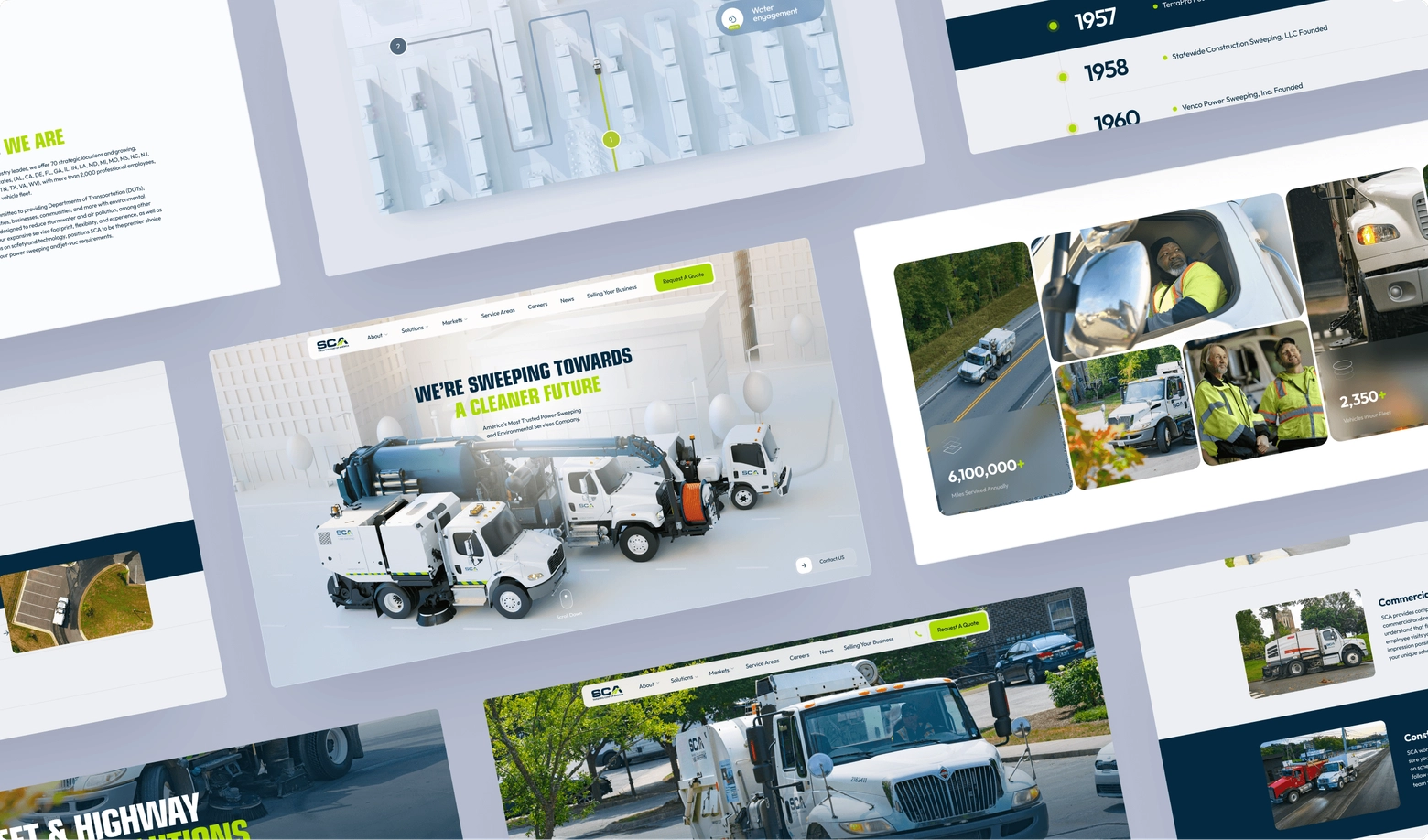
Sweeping Corp of America came to us with a different challenge. The company already had an established brand, multiple service areas and a large amount of existing content.
The goal was not to reinvent the business, but to organize its digital presence more effectively. We focused on simplifying navigation, improving the way services were presented, creating reusable components and building a flexible platform that could grow with the company.
Although the final experience feels clear and straightforward, the project required extensive work on content structure, scalability, responsive behavior and CMS implementation.
These two projects demonstrate why websites with a similar number of pages can require very different levels of strategy, design and development.
Planning a website redesign?
Every project starts from a different point. Some companies need a focused visual refresh. Others need to rethink their positioning, structure, content and technology before moving into design.
Send us your current website and tell us what is no longer working. We will help define the right scope, team and budget for the project.
Frequently Asked Questions
How much does it cost to redesign a small website?
A focused visual refresh may cost around $10,000 – $15,000. A full redesign of a small marketing website, including custom UX/UI design and development, typically falls in the $15,000–$20,000 range.
How much does a complete website redesign cost?
A complete custom redesign covering information architecture, UX, visual design and development usually starts at around $20,000–$30,000. Larger corporate and enterprise projects can reach $50,000 and above, especially when the scope includes branding, content strategy, 3D, advanced motion design or complex integrations.
Is development included in the website redesign cost?
Not always. Some agencies provide strategy and design only, while others manage the entire process through development and launch.
The proposal should clearly state whether the estimate includes frontend and backend development, CMS integration, content migration, quality assurance, deployment and post-launch support.
Can you redesign a website without rebranding the company?
Yes. If the existing brand identity still reflects the company and supports its future goals, the redesign can focus on information architecture, user experience, visual refinement and the digital application of the brand.
A rebrand is only necessary when the existing identity, positioning, or messaging no longer represents the business.
Can a website redesign negatively affect SEO?
Yes. Changing URLs, navigation, page structure or content without a proper migration plan can lead to broken links, indexing issues and a decline in organic traffic.
Before launch, the team should map old URLs to new ones, implement redirects, preserve important metadata, review internal links and verify that search engines can crawl and index the new website correctly.